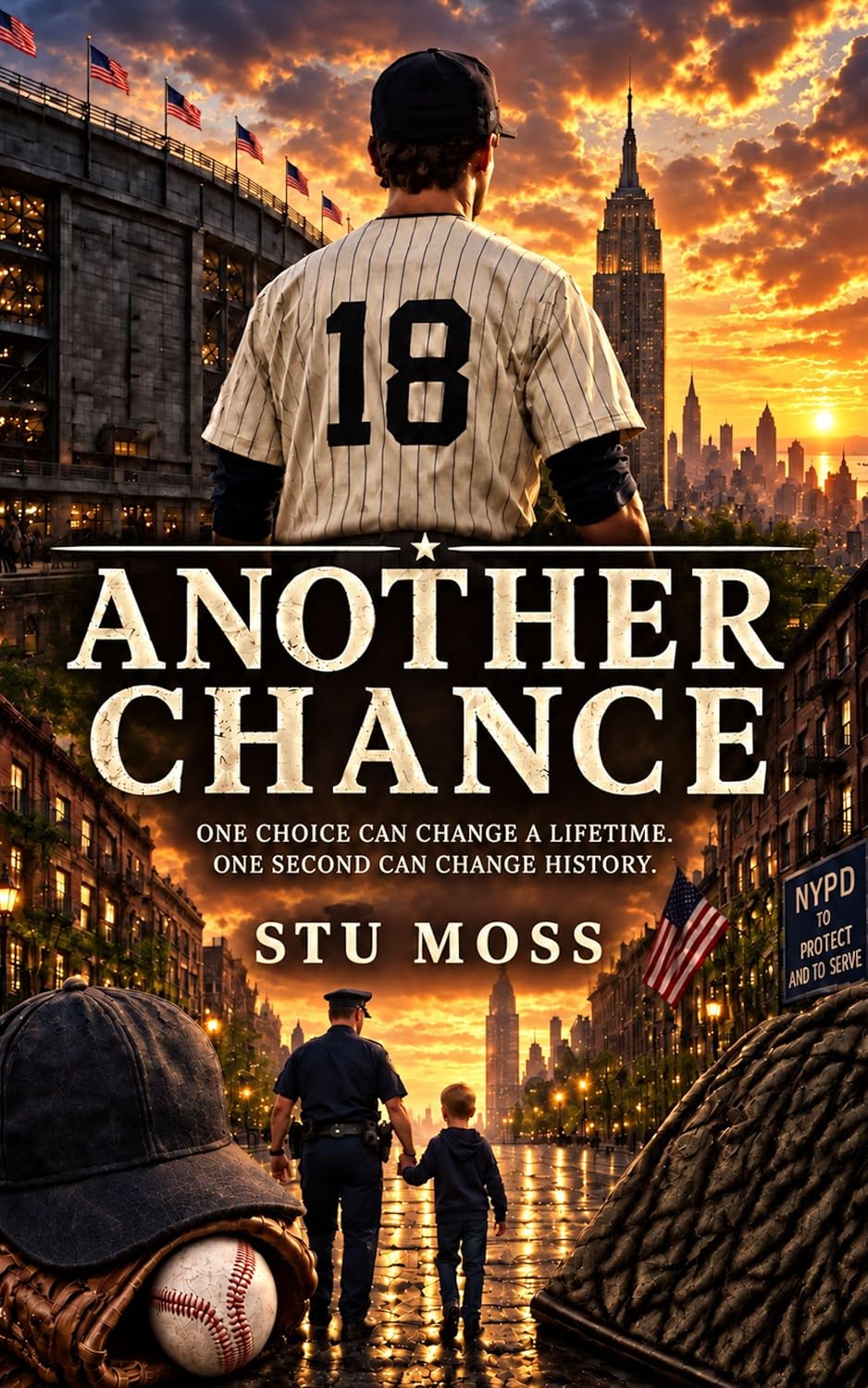
Stu Moss’ Another Chance follows Jesse Landon, born
in a Depression-era Bronx apartment to a mother who meets his dreams with
silence. He has one sanctuary: baseball. When a Yankees scout offers him a
contract at seventeen, his mother tears it to pieces with the verdict: “No ball
player is ever guaranteed a future.” Jesse builds a beautiful life anyway,
serving in Korea, joining the NYPD, marrying Joyce, and raising Zach, teaching
him that “every father ought to teach his son how to play catch.” Yet the
question lingers: what if? Then, in 2006, a single throw strikes Zach’s
head, and seventy-two-year-old Jesse awakens in 1951, seventeen again, signing
with the San Francisco Seals. What follows is the life he might have lived: pennant
races, World Series glory, and a bond that refuses to be forgotten. Meanwhile, in
a quietly altered timeline, his son searches for a father he can't remember.
Moss writes with the heart of a fan and the eye of a gifted
historian. Character work is impeccable, and Jesse is endearing. He instantly
steals your heart when, as a boy, he vows: “One day... someone will be proud of
me.” He grows into a father too humble to believe Zach when he insists, “You
could've made it, Dad.” The worldbuilding dazzles with historical authenticity:
Lefty O'Doul's Seals, Mazeroski's 1960 walk-off, Don Larsen's perfect game, Maris’s
sixty-first home run. The pacing is masterful, with decades of real-life sweep
past before the narrative slows to savor every at-bat of Jesse's eleven-season
career. Moss's most haunting device is the notebook, its fading entries
(''If I ever read this and the name Zach means nothing to me...'')
turning memory into a ticking clock, while David Robinson's parallel story
keeps pages flying. When both timelines collide at Old-Timers’ Day over a 1966
Topps card, the payoff devastates and heals. Another Chance reads like a
love letter to baseball, fathers, and sons, and it cleverly explores the
magnificent possibility of another chance.







 Mommys_Boy_6x9.jpg)





.jpg)































.jpg)


 JPEG.jpg)













.jpg)































































.jpg)