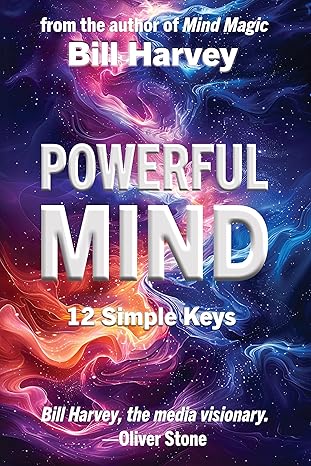
In Powerful Mind: 12 Simple Keys, Bill Harvey offers
a comprehensive guide to reclaiming mental autonomy in an age of overwhelming noise,
what he calls the Acceleritis culture, which drives us all at top speed by
giving us too many stimuli nearly all the time. This book addresses a question
that every human being should consider, especially in this time of information
overload: “What does it mean to use more of our mind, which is a tool we
already have?” Harvey starts by arguing that we suffer from an accelerating
information overload that forces the brain into an “Emergency
Oversimplification Procedure” (EOP), severely limiting creativity and authentic
living. Structured into an Owner's Manual and twelve actionable keys, the book
presents tools to help anyone transition from a reactive state toward the “Observer
State” and ultimately the “Flow State.” In this book, you’ll access tools that
allow you to outsmart hasty closure, learn to do it your way, master the art of
consistency, outgrow the need to keep scores, improve your mental clarity, and
a lot more.
Bill Harvey fascinates me with how well he combines neuroscience
with philosophical insights to create a pathway to optimize internal
information processing. His take on making the shift from domination-based
living to collaboration and love resonated most with me. Powerful Mind
is one of those rare books that explore metacognition, self-discipline, and the
conscious universe with simplicity and in a language that is not just
accessible but enjoyable to read. Harvey argues that much of our behavior is
driven by a “bio-AI” or “robot”—conditioned responses imposed by society—rather
than our authentic selves. The twelve keys are practical tools to dismantle
these automatic patterns. Specific strategies encourage readers to identify
true desires beyond social conditioning and build resilience against modern
distractions. The author suggests that recognizing our interconnectedness
within a single consciousness fosters nobility and reduces conflict. He
critiques materialistic accidentalism, advocating an open-minded empiricism in
which positivity and gratitude actively shape reality. There is so much to
comment on in this groundbreaking work, but I will leave you with this: the
greatest merit of this book is its wisdom and the tools it offers to help
anyone use their mind to take control of their life, to influence others, and
to experience deeper levels of inner freedom.



 Mommys_Boy_6x9.jpg)





.jpg)






















.jpg)



.jpg)





.jpg)



.jpg)
.jpg)






.jpg)


 (2).jpg)


.jpg)









.jpg)



.jpg)




.jpg)




















.jpeg)






.png)




 (1).jpg)


.jpg)







.jpg)