Author Sanjay Sabnani Talks About the Power of Discomfort: Turning Pressure into Action, Learning to Receive, and Finding Peace Beyond Striving
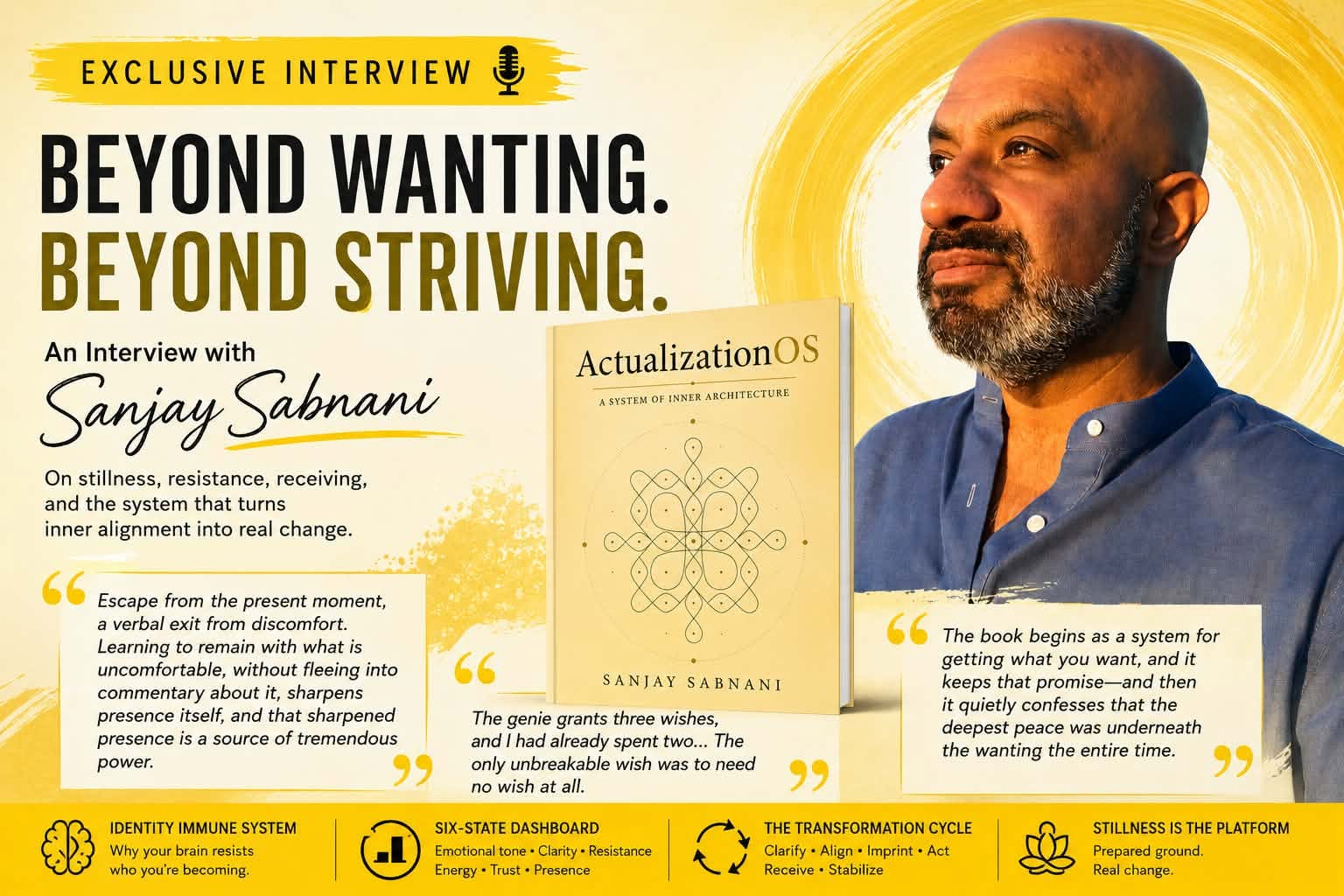
Discover why your brain sabotages success and how to rewire your identity in this ActualizationOS interview on stillness, self-sabotage, and lasting change.
In 2015, Sanjay Sabnani’s business and marriage collapsed at the same time—and with them went an identity built entirely on the roles of husband and provider. What followed wasn't a comeback powered by positive thinking, but a complete re-engineering of the self from beneath the level of thought. The result is ActualizationOS, a system uniting ancient wisdom from Yoga, Stoicism, and Buddhism with modern neuroscience. In this interview, Sanjay Sabnani unpacks the “Identity Immune System” behind self-sabotage, explains why stillness is the foundation of achievement, reveals how complaining drains the energy change requires, and shows why receiving success can feel as dangerous as losing it. If lasting change has eluded you, this conversation explains why—and what finally works.
The Origin
You write that ActualizationOS was born from a "fundamental systems failure" in 2015 when your business and marriage collapsed at the same time. How did that double crisis force you to stop relying on sheer intellect and re-engineer your life from the inside out?
My identity had become a construct built upon the roles I played as husband and provider. Losing both at the same time left me in a dark place where I no longer knew who I was or what my life meant. I did not know what to apply my intellect toward, and if I am being honest, I did not want either the marriage or the success back. I only wanted my existence to end. That was the moment I discovered the limits of the instrument I had relied on my entire life, because the intellect can analyze a collapse with perfect clarity while remaining unable to survive it. The failure was not in my thinking but in the layer beneath it, where identity, nervous system, and attention operate without asking permission. Little did I recognize that grace had given me a tremendous opportunity: for the first time, I could look at myself as both the cause of my problems and their solution. The re-engineering had to begin beneath the intellect, and everything in the book follows from that inversion.
The intellect can analyze a collapse with perfect clarity while remaining unable to survive it.
Why Change Fails
What is the "Identity Immune System," and why does our brain actively fight back when we try to make sudden leaps toward success or abundance?
Our minds construct an image that we unquestioningly adopt as who we are. The image is actually a boundary, designed by the mind in a misguided attempt to keep us safe while leaving us dependent on the mind itself. The Identity Immune System is my name for what defends that boundary. If we attempt anything that mismatches the self-image, powerful subconscious forces run a course correction through subversive means: doubt, distraction, fatigue, self-sabotage. The mind cannot accept anything colored outside of its lines, even when this is to the detriment of its host. This is why sudden leaps toward success or abundance fail so reliably. The problem is not weak willpower or insufficient desire. The goal simply does not match the setting, and the system pulls you back to baseline the way a thermostat holds a room at its programmed temperature. You do not defeat an immune system by fighting it. You retrain what it recognizes as self, through small behaviors repeated until the new identity stops registering as foreign.
Stillness as the Platform
You write: “The mind cannot create what the system cannot sustain.” "Stillness is not preparation for getting what you want—stillness is the end of wanting and the beginning of having."
There are layers to stillness that exceed my ability to describe, but an immediate answer is that inner architecture requires the capacity to see the movement and mechanics of the mind, and only stillness provides that vantage. Stillness is what the mind and this world operate on. We assume the background moves along with thought because that is where our attention goes, but the background is silent and unmoving. This is why I refuse to call stillness a warm-up. A warm-up prepares you for the real activity. Stillness is the real activity, the platform on which every other practice in the system runs. Consider what happens when an agitated person visualizes abundance: the nervous system broadcasts threat alongside the image, so what gets imprinted is the anxiety, not the abundance. The mind cannot create what the system cannot sustain.
Accessing stillness is the secret to all human mastery.
The ancient wisdom traditions recognized this plainly, and modern times have almost completely disregarded it, which is much of why sincere effort fails so often today.
The Six-State Dashboard
Your diagnostic model asks us to check our internal state before taking action. What happens when someone tries to force goals or visualization while their nervous system is agitated or shut down?
When someone tries to run imprinting or visualization from an agitated or shut-down state, the process works against itself in a specific way. The subconscious does not just receive the content of the image. It receives the content plus the emotional charge it is wrapped in. If you are forcing a vivid picture of success while your nervous system is in alarm, the impression that actually lands is closer to “success feels dangerous and strained.” That is what gets rehearsed. Agitation is not neutral background noise. It is an active signal. The subconscious reproduces dominant inputs, and if fear or urgency is the loudest thing in the system when you sit down to visualize, fear and urgency are what you strengthen, regardless of what the imagery shows. The shutdown case is a different problem. When someone is emotionally numb or dissociated, there is no feeling available to charge the impression. The subconscious needs feeling to take an input seriously. Flat, mechanical repetition of affirmations in that state produces almost nothing. It is like sending a message with no signal. There is also a third problem: forcing practice in either state teaches the system to associate inner work with strain, and that association compounds, making practice feel increasingly effortful. The system treats this as a state-stage mismatch, not a failure of effort or willpower. The person is not broken. They are trying to run a process their foundation cannot hold yet. Most failures are misapplications, not misfortunes.
Training Attention
Why do you recommend starting with "coarse focus"—like rhythmic speech or audible repetition—before attempting subtle practices like breathwork or visualization?
Think back to when you learned your multiplication tables. It began with writing the tables out, perhaps along with recitation: two times twelve is twenty-four, three times twelve is thirty-six, and so on. That was coarse focus. Eventually, with practice and repetition, the multiplication framework became internalized, and your engagement with it became subtler and subtler until the answers simply arose. If you had been asked to begin with an internal representation of multiplication based upon its subtle aspects, the process would likely have taken longer, and the journey would have been far more frustrating. Attention training follows the same law. Subtle practices like breathwork and visualization require an attention that can hold a faint object steadily, and the untrained mind slides off such objects within seconds, then spends the session in discouraged wandering, which trains exactly the wrong thing. Coarse focus gives attention an object it cannot lose. Rhythmic speech and audible repetition are loud, embodied, and continuous, so attention has something to grip. Start coarse, build stability, and the subtle practices open on their own. Start subtle without stability, and you are practicing frustration.

Ancient Wisdom Meets Neuroscience
How did you realize that ancient practices from Yoga, Stoicism, and Buddhism were describing the exact same mechanisms as modern neuroscience concepts like Predictive Coding and the Default Mode Network?
The three traditions I used for reference, Yoga, Stoicism, and Buddhism, all surprised me during my process of rebuilding after the collapse. They successfully reproduced my mental fixations and prescribed working solutions where therapy, self-help books, and talking to friends could not. I want to be precise about the direction of the discovery. I did not go looking for neuroscience concepts in ancient texts. I looked to see whether modern science had finally caught up to what these sages taught millennia ago, and again and again it had. The wandering, self-referential chatter that Patanjali called the fluctuations of the mind is what researchers now image as the default mode network. The Buddhist observation that we suffer from our projections rather than from events is predictive coding stated without the mathematics. These traditions were not being poetic. They were being empirical, running multi-generational experiments on attention and identity with the only instrument available to them, direct observation, and their results replicated across cultures that had no contact with one another. That independent replication is what convinced me the mechanisms are real. The book treats the traditions as prior art, not decoration.
The Physics of Complaining
You state that complaining or "venting" bleeds off vital energy. How does withholding complaints create the internal pressure needed for real change?
Treat it as an energy accounting problem rather than a moral one. A setback generates internal pressure, and that pressure is uncomfortable, which is exactly why it is valuable. Discomfort is stored energy, and it is the precise fuel required to shift an identity or take a difficult action. When you complain, you open a pressure valve. The venting produces immediate relief, along with a small payment of sympathy, and in exchange the pressure that could have powered change dissipates into the air. You have traded the energy of actualization for the cheap comfort of being a victim. Withholding the complaint is not suppression, and the distinction matters. Suppression denies the feeling. Containment feels it fully and declines to discharge it, the way an engine contains combustion instead of letting it explode uselessly in open air. There is a deeper yield as well. Complaining is at its root an escape from the present moment, a verbal exit from discomfort. Learning to remain with what is uncomfortable, without fleeing into commentary about it, sharpens presence itself, and that sharpened presence is a source of tremendous power that extends far beyond the original grievance. Contained pressure demands an outlet, and if the verbal outlet is closed, the pressure finds the behavioral one. I ask readers to run the experiment for one week. Contain what you would have vented and watch what the pressure does when it is given no exit except action.
The Difficulty of Receiving
Why do so many people struggle with the "Receive" stage of your cycle, and why can getting what we asked for actually trigger fear or anxiety in the nervous system?
Receiving is the stage where the Identity Immune System makes its final stand. People assume that getting what they asked for will feel like relief, and then the arrival triggers anxiety, sabotage, or a sudden urge to deflect, and they conclude something is wrong with them. Nothing is wrong. The mechanism is working exactly as designed. What you receive changes who you are, and the nervous system registers identity change as threat regardless of whether the change is desirable. The new relationship, the money, the recognition each announces that you are now someone else, and the system answers with the same alarm it would sound for danger. There is also a structural problem with how we wait for outcomes. Grasping narrows the channel. The clenched posture of needing it broadcasts scarcity to the very system that must relax to take delivery. This is why things so often arrive the moment we genuinely stop needing them, not as cosmic reward but as simple mechanics. Releasing widens the channel. Receiving is therefore a practiced skill, not a passive event. The practice is allowing the good thing to land without flinching, in increments small enough that the immune system does not mobilize.
Moving Beyond Striving
In the book's conclusion, you talk about the "third wish"—the wish to need no wish at all. What does it look like to shift from a life of constant striving to simply living as a quiet conduit for your work?
The genie grants three wishes, and I had already spent two. The first was love, and it arrived, and it ended. The second was success, and it arrived, and it ended. Both taught the same lesson: every granted wish carries its shadow, because the moment you receive what you wanted, you begin to fear its loss. Follow any candidate's third wish honestly to its end, and you find the same shadow waiting. The only unbreakable wish was to need no wish at all. Living that way looks less dramatic than it sounds. The work continues, and in my case, it intensified, but the work stops being a claim I am filing against reality. I write, I build, I publish, and the outcomes route through me rather than to me. A conduit does not audit what flows through it. The strangest discovery is that output improves when the striving stops, because striving was friction, the clenched self-standing in its own channel. The book ends there deliberately. It begins as a system for getting what you want, and it keeps that promise, and then it quietly confesses that the deepest peace was underneath the wanting the entire time.
____________________________
About the Author
Sanjay Sabnani is an author and independent researcher in Causal Neuro-Symbolic AI. He serves as a senior executive and board member at a private-equity-owned technology company, where he leads legal, compliance, governance, and AI research and development.